
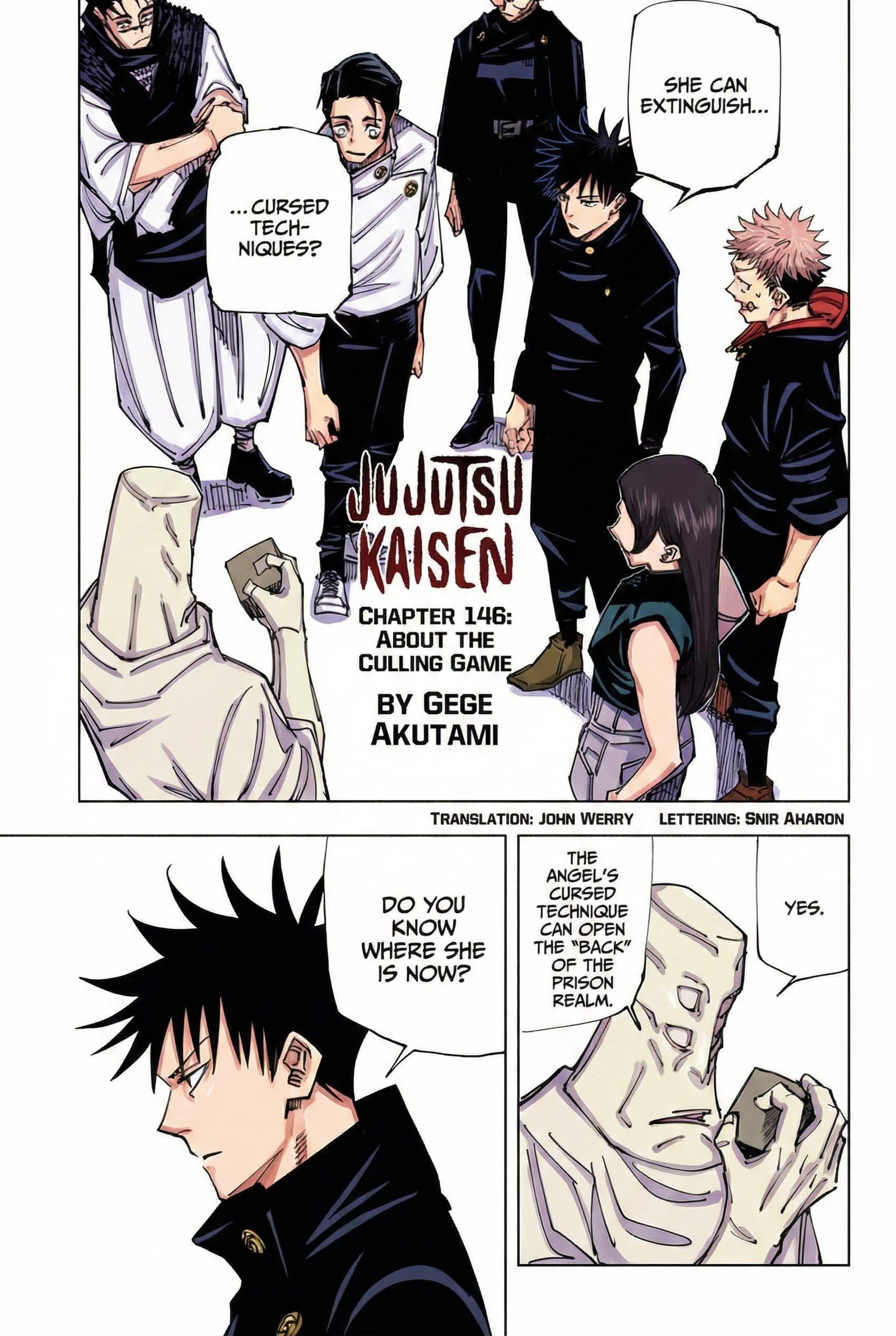
Jujutsu Kaisen – Chapter 146: about the culling game
English Translation:
The room is silent, but the tension is heavy.
Megumi finally speaks.
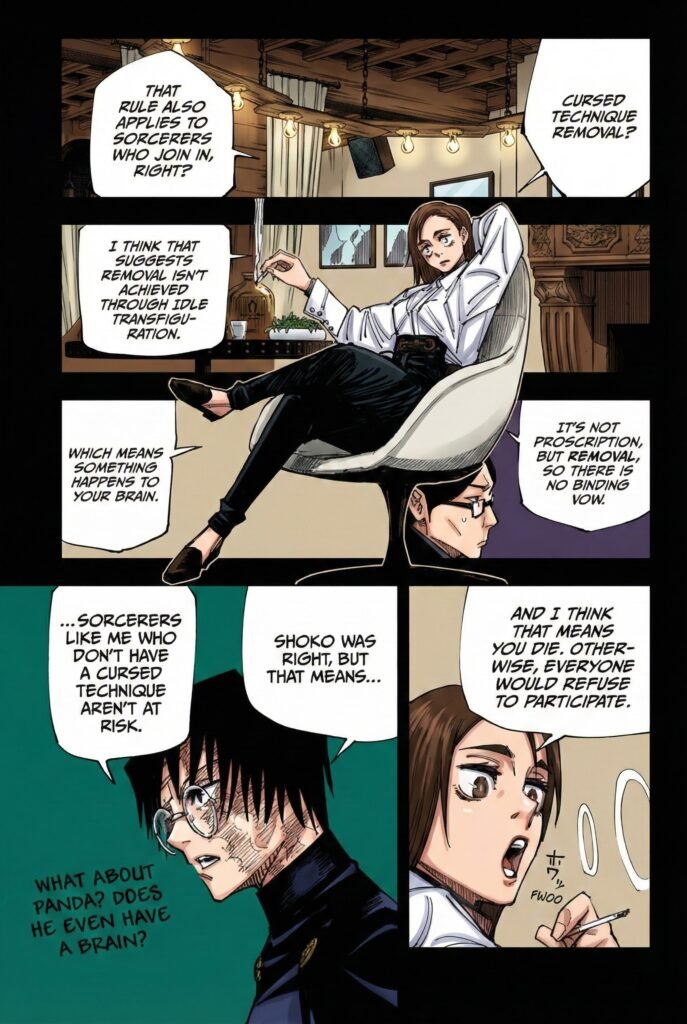
“Technique removal… so the Prison Realm’s back gate can only be opened using Angel’s technique.”
Everyone understands what that means.
If they want to free Satoru Gojo, they must find Angel first.
Megumi looks toward Tengen.
“Do you know where Angel is?”
Tengen answers calmly.
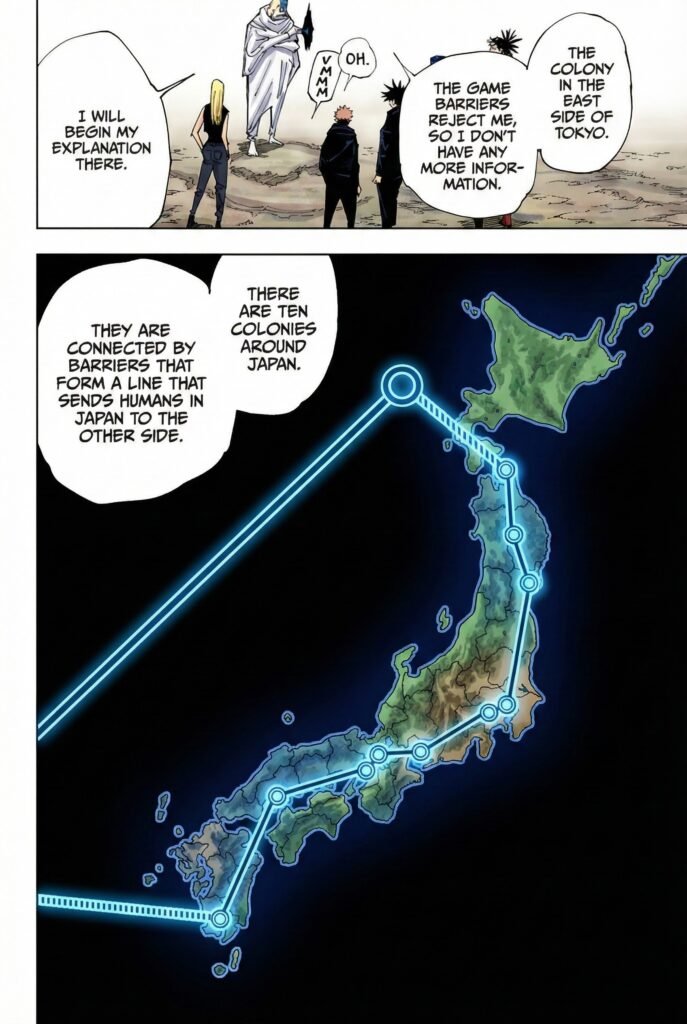
Angel should be located in a colony on the east side of Tokyo.
But the information is incomplete.
Even Tengen cannot see everything inside the Culling Game.
The reason is simple.
The barrier of the Culling Game rejects Tengen’s influence.
Now the group focuses on what they do know.
Tengen explains the structure of the battlefield.
Across Japan, there are ten colonies created by the game.
Each colony is connected to the others through the barrier system.
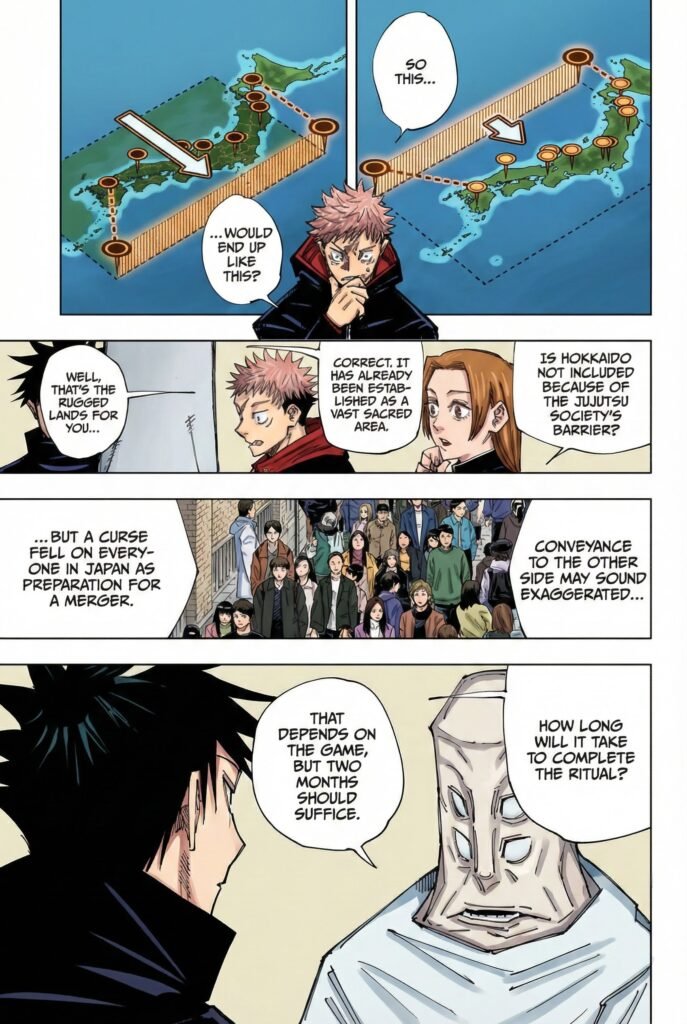
Yuji imagines the layout in his head.
“So the entire country is divided into zones like this.”
But one place is missing from the map.
Hokkaido.
Yuki Tsukumo explains why.
Hokkaido already has a powerful barrier maintained by the Jujutsu organization.
Because of that protection, the Culling Game could not expand there.
In a way, Hokkaido is considered a sacred region.
Yuki then turns her attention back to the real problem.
Also Read: jujutsu-kaisen-chapter-160
Kenjaku’s plan.
According to her theory, the Culling Game is only preparation.
The real goal is to merge the people of Japan with Tengen.
A massive ritual.
But rituals of this scale require time.
Someone asks the obvious question.
“How long will it take?”
Tengen answers carefully.
That depends on how the game progresses.
But most likely… around two months.
Now they begin reviewing the rules of the Culling Game.
The first rule is critical.
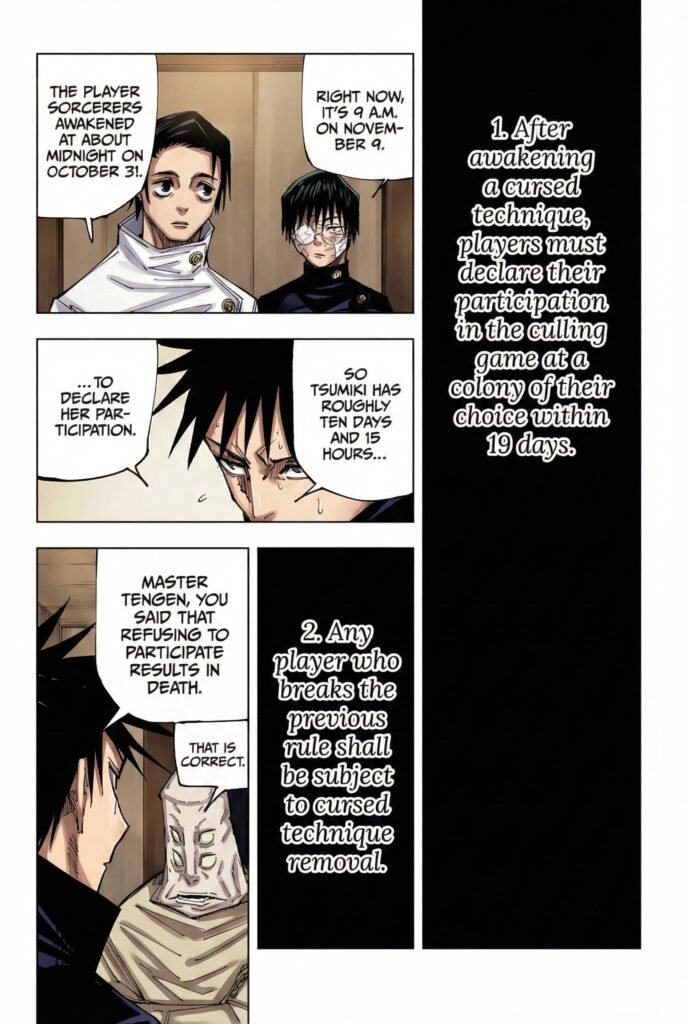
After awakening their cursed technique, every player must declare participation within nineteen days.
Maki checks the current time.
It is November 9th, 9 AM.
Yuta adds another detail.
Most players awakened on October 31st.
Megumi immediately calculates the timeline.
That means Tsumiki still has about ten days and fifteen hours left before the deadline.
But the second rule makes things far more dangerous.
If a player refuses to participate after awakening their technique…
their technique will be removed.
Yuji asks the question everyone is thinking.
“Does that mean they die?”
Tengen explains that even Shoko once discussed this possibility.
Technique removal does not mean banning someone from the game.
It means taking the technique directly from their brain.
Tampering with a sorcerer’s brain could easily lead to death.
Maki agrees with that interpretation.
But there is one exception.
People without cursed techniques… like Maki herself… will not face that risk.
Yuji then looks toward Panda.
“And Panda?”
No one answers immediately.
The third rule creates another layer of danger.
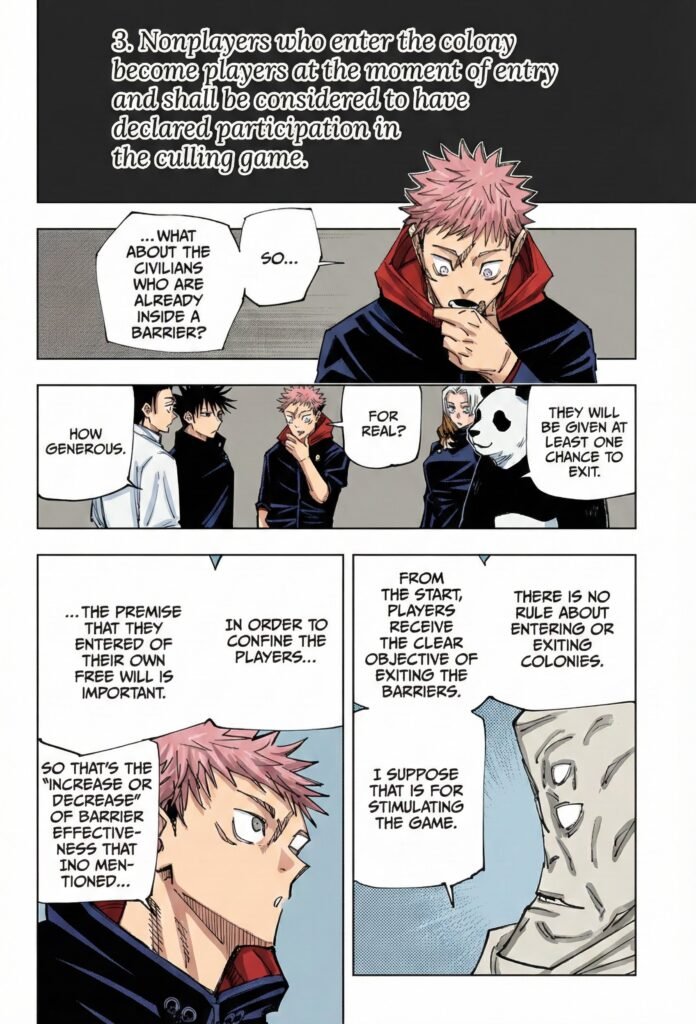
Anyone who enters the barrier without being a registered player… automatically becomes one.
Yuji remembers something else.
“What about people who were already inside the barrier before the game started?”
Tengen explains that they will be given one opportunity to leave.
But this is only allowed at the very beginning.
After that moment passes, the barrier becomes a trap.
Players must enter the colony willingly in order to be bound by the game.
The fourth rule explains how players earn points.
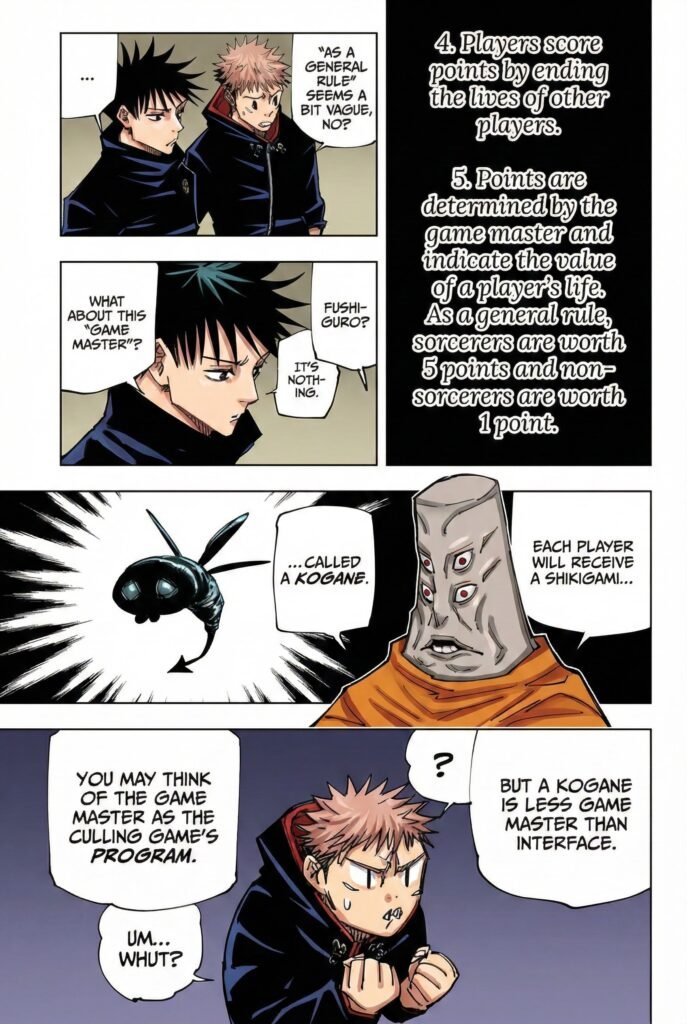
They gain points by killing other players.
And the fifth rule defines the value of each kill.
A sorcerer is worth five points.
A normal human is worth one point.
Yuji frowns as he realizes something.
“This rule hides another rule inside it.”
Megumi nods.
Then he asks Tengen about something else.
Earlier, Tengen mentioned the Game Master.
Who is controlling everything?
Tengen clarifies the misunderstanding.
Every player receives a small shikigami called Kogane.
But Kogane is not the Game Master.
It is closer to a clerk, simply managing the system.
In truth, the Culling Game itself functions as the master.
Yuji struggles to process the idea.
A game… controlling itself.
Then comes the sixth rule.
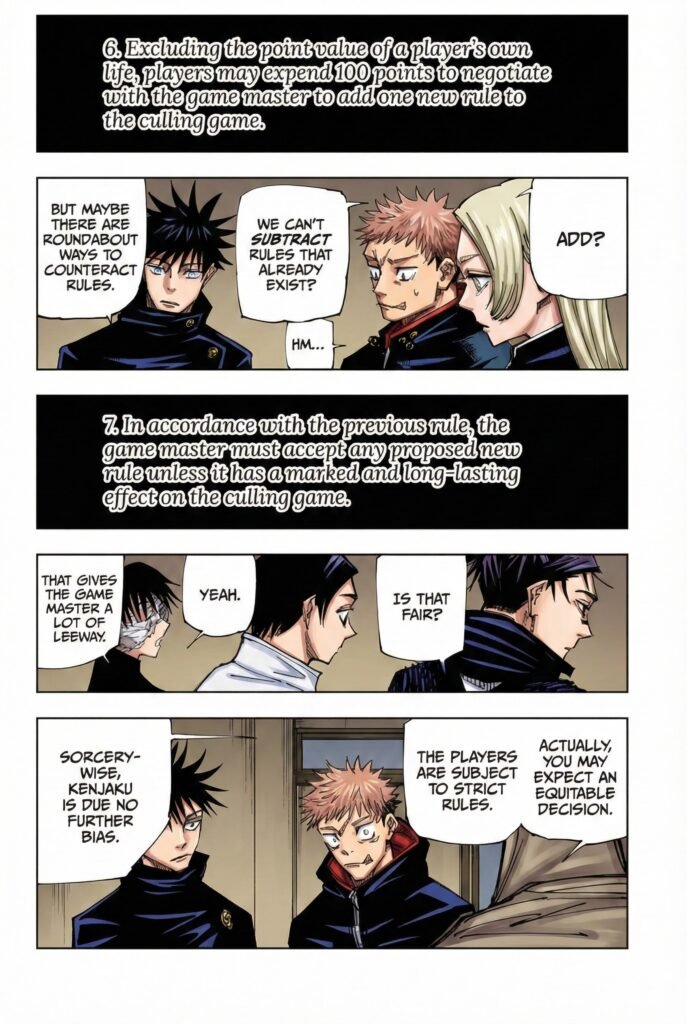
If a player collects one hundred points, they can use those points to add a new rule to the game.
Yuji immediately asks if that means they can delete existing rules.
Megumi shakes his head.
They cannot erase rules.
But they might be able to add indirect rules that change how the game works.
The seventh rule limits that strategy.
No player can add a rule that would fundamentally break the game’s long-term balance.
Choso quietly asks if Kenjaku gains any special advantage from these rules.
Tengen answers honestly.
No.
Even Kenjaku must follow the same system.
However, as the one who created the game, he already shaped its structure.
The eighth rule adds constant pressure.
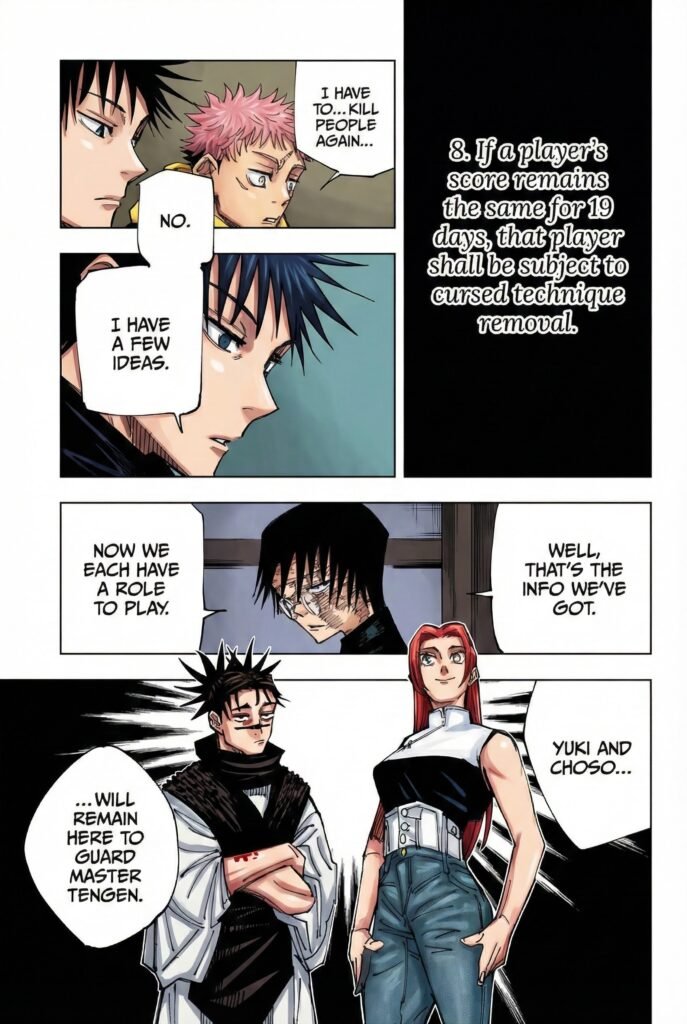
If a player’s points remain unchanged for nineteen days, their cursed technique will also be removed.
Yuji finally understands the brutal logic.
“So… players are forced to kill.”
Megumi responds calmly.
“Not necessarily.”
He believes there might still be a way to work around that rule.
At this point, the group has gathered enough information.
Maki shifts the conversation to strategy.
Roles must be decided.
Yuji and Choso will stay here for now, protecting Tengen.
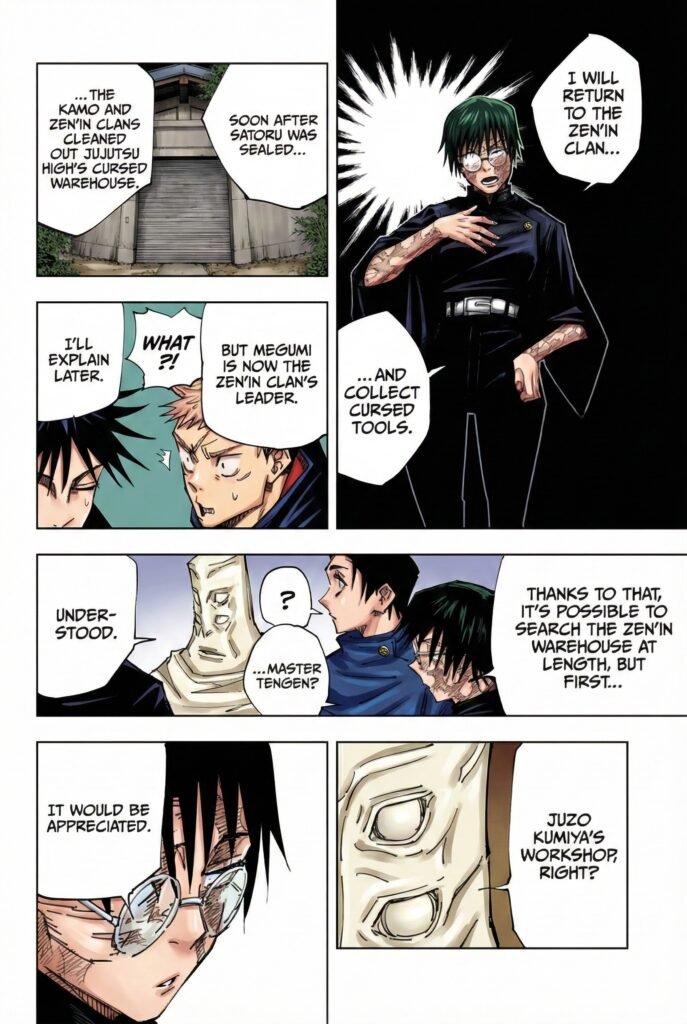
Meanwhile, Maki has her own mission.
She plans to return to the Zenin Clan estate and collect as many cursed tools as possible.
When Satoru Gojo was sealed, the Zenin family moved most of the weapons from the Tokyo storage rooms into their own vault.
Now the Tokyo storehouse is completely empty.
But something unexpected has changed.
Megumi has become the new head of the Zenin Clan.
Yuji is shocked by the news.
Megumi only says he will explain later.
Before leaving, Maki asks Tengen about one more thing.
The Kumiyai Workshop.
It is connected to a legendary cursed tool creator.
Tengen confirms the location.
Maki thanks him.
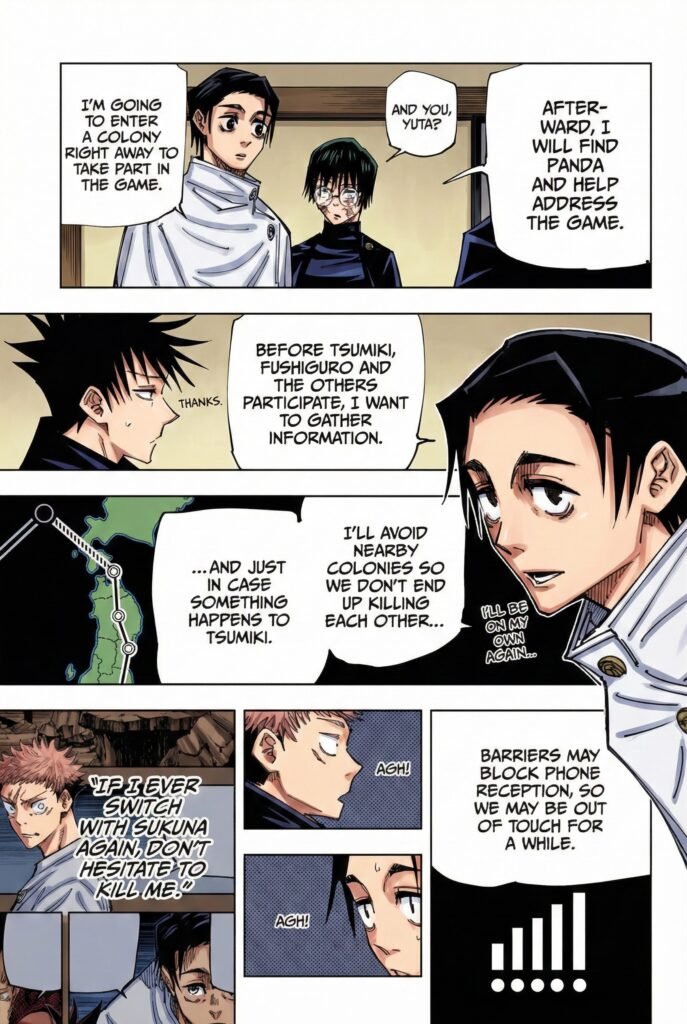
After collecting the tools, she plans to regroup with Panda.
Yuta then reveals his own decision.
He will also enter the Culling Game.
But not near Yuji or Megumi.
His goal is to gather information first.
If possible, he wants to prevent unnecessary fights between allies.
There is another concern.
Inside the barriers, electronic signals may not function properly.
Communication between colonies could become impossible.
Megumi understands the real reason behind Yuta’s choice.
If Ryomen Sukuna takes control of Yuji…
even Yuta might struggle to stop him.
Keeping distance may actually protect everyone.
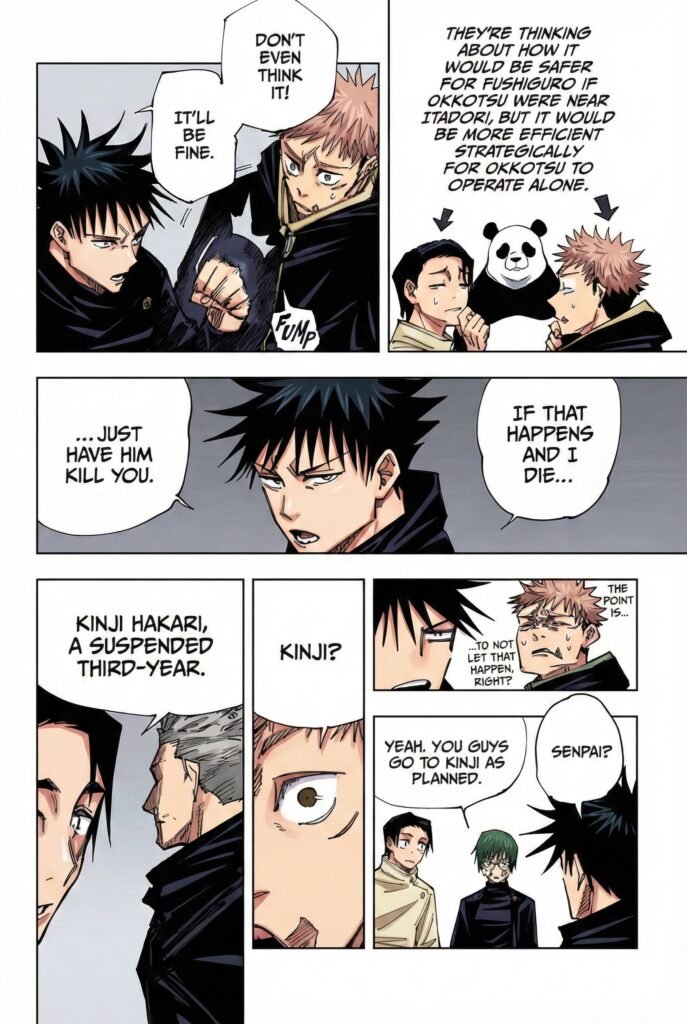
Megumi finally speaks.
“We don’t have time to keep debating this.”
Then he says something that freezes the room.
“If I die… kill me afterward.”
Yuji immediately rejects that idea.
He wants to avoid that outcome completely.
Maki adds another request before leaving.
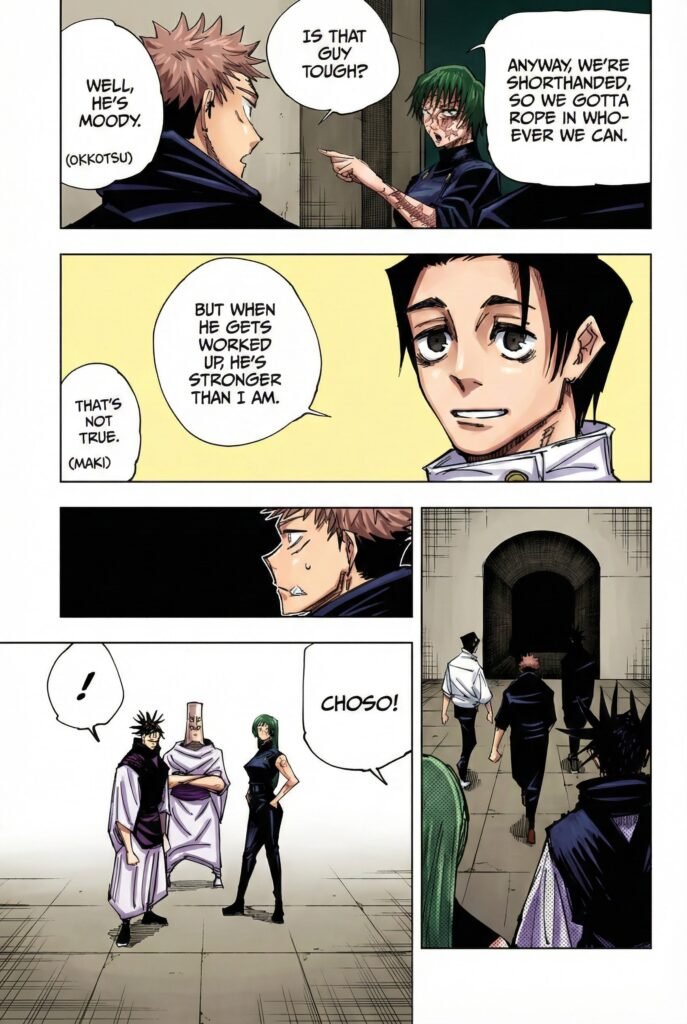
They should also search for Kinji Hakari, the suspended third-year student.
Yuji asks if Hakari is really that strong.
Yuta answers honestly.
Hakari can be difficult to handle.
But when he is serious… he might even be stronger than Yuta.
Maki quickly denies that exaggeration, but the message is clear.
Hakari would be a valuable ally.
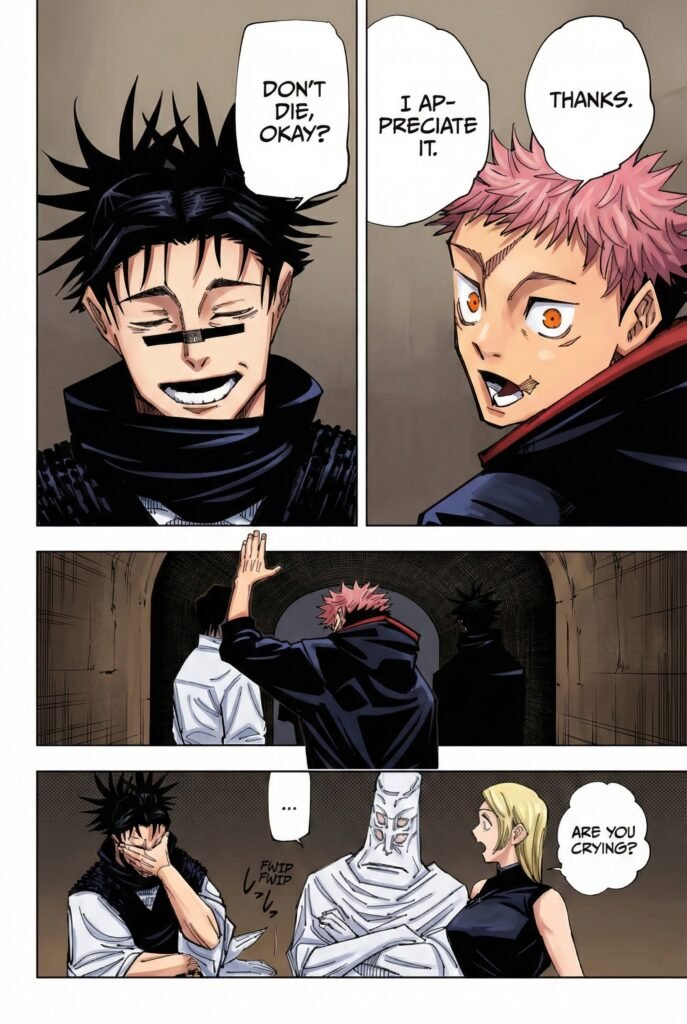
As everyone prepares to separate, Yuji turns to Choso.
“Thank you… for helping me.”
Choso looks at him quietly.
“Just don’t die.”
After the others leave, Choso remains behind.
And suddenly… he starts crying.
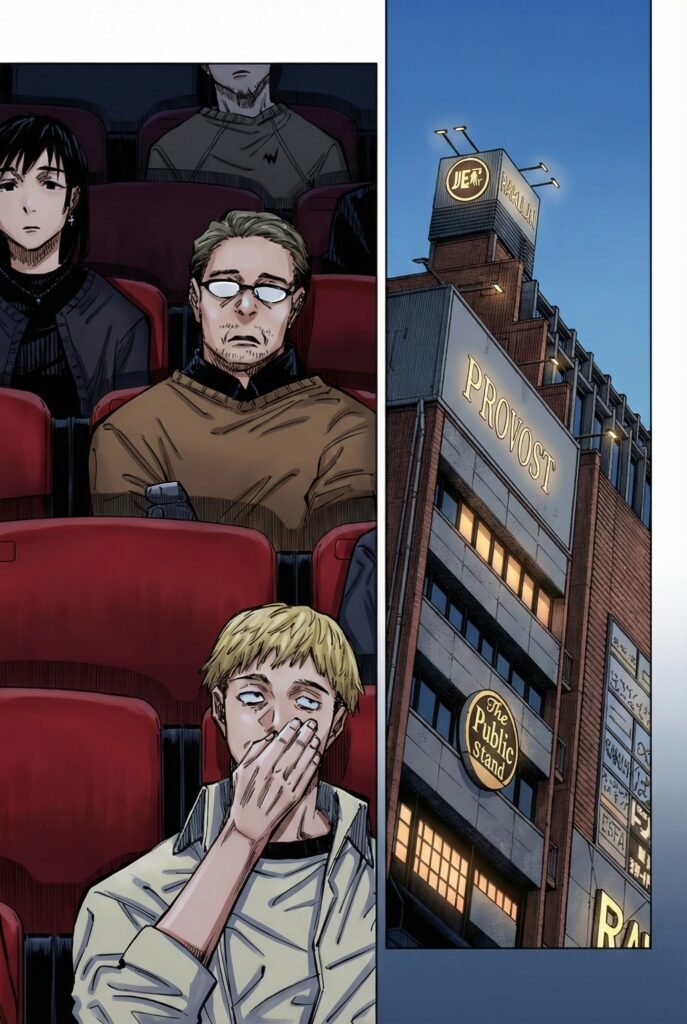
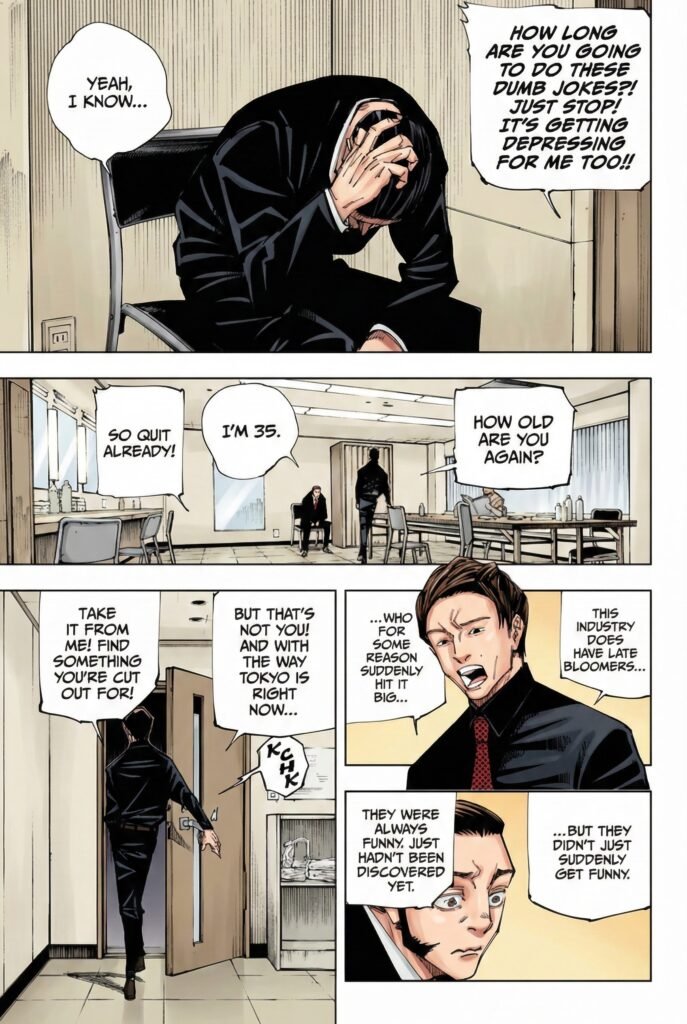
Far away from all this planning, another scene unfolds.
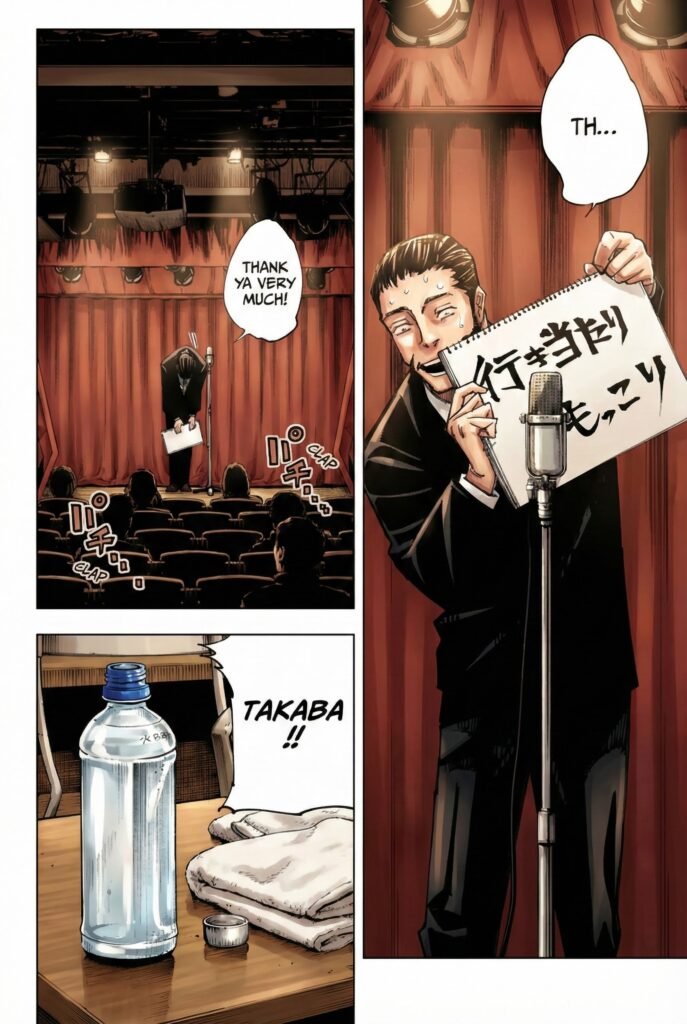
A small comedy stage.
A comedian finishes his performance.
But no one laughs.
The audience stays silent.
The performer thanks them politely and walks off stage.
Backstage, the manager explodes with frustration.
“How long are you going to keep doing this?”
The comedian is already thirty-five years old.
The manager tells him to quit.
This industry is filled with people who rise to fame later in life.
But those people were always funny from the beginning.
They just weren’t noticed yet.
“You are not like them,” the manager says coldly.
“Tokyo is ruthless. Find another job.”
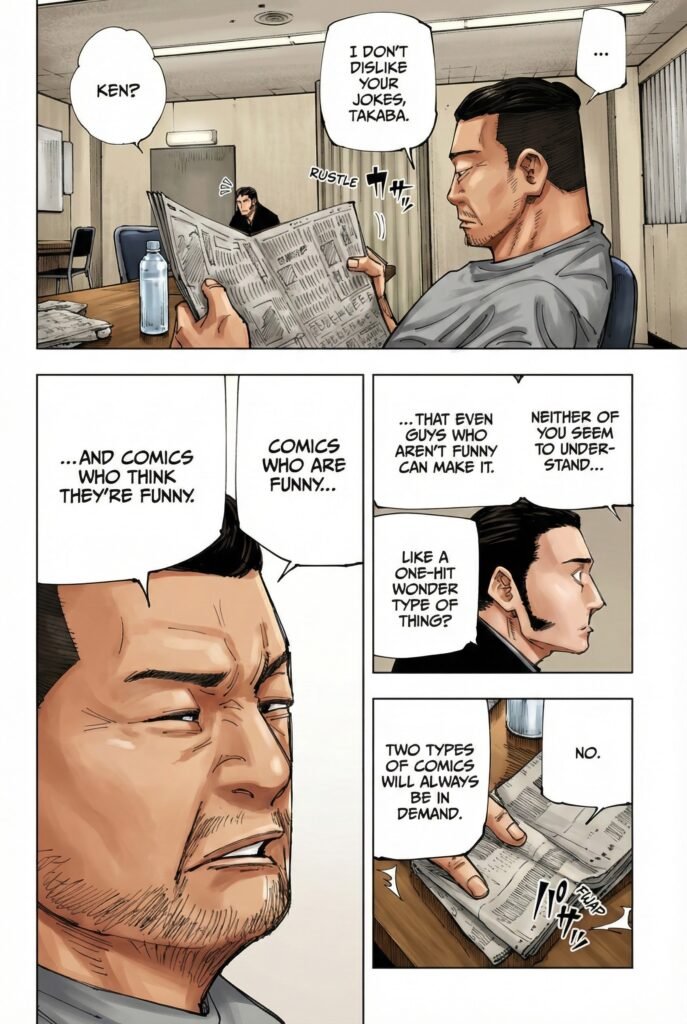
The comedian’s friend tries to comfort him.
He actually likes the man’s material.
But the comedian responds with an unusual observation.
Popularity does not always depend on being funny.
Some people succeed simply because they believe they are funny.
He explains that there are two types of people who remain popular.
Those who are genuinely funny.
And those who are completely convinced that they are.
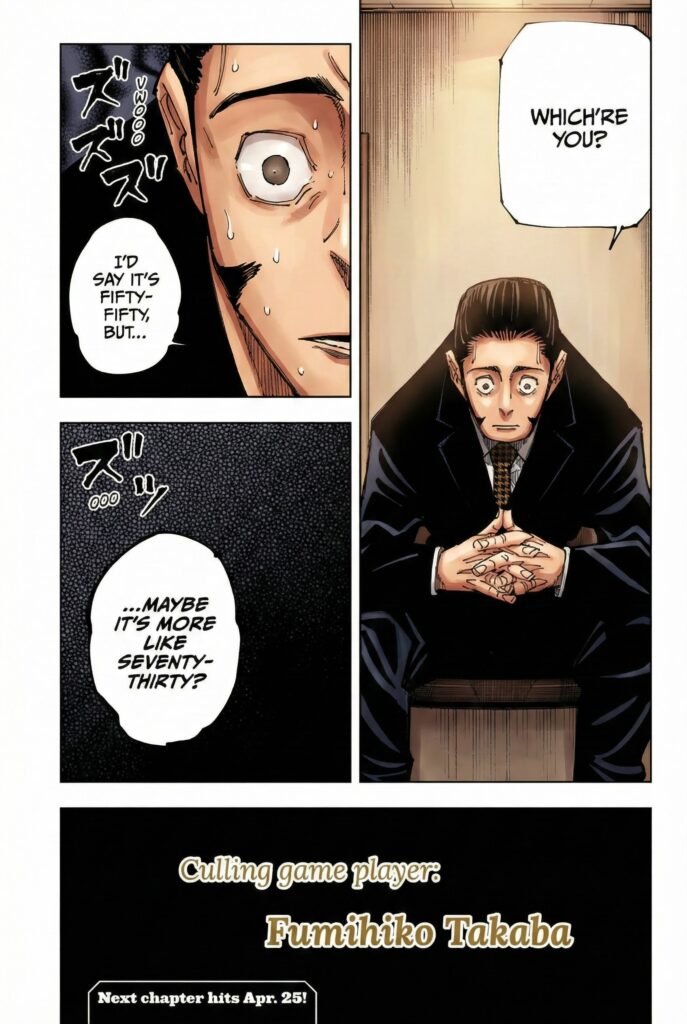
His friend asks a strange question.
“So which type are you?”
The comedian smiles slightly.
“You think it is fifty–fifty.”
But in reality…
“It is more like seventy–thirty.”
Then he says one quiet phrase.
“The Culling Game.”
And just like that…
a new player quietly steps toward the battlefield.